


I have been following this court case for some time now, and I wanted to share the latest update that I received from the Tybee Alliance on August 20th:
The Tybee Alliance is proud to share an important update on our ongoing efforts to protect vacation rental rights on Tybee Island. Our organization was founded to advocate for fair treatment of short-term vacation rentals (STRs) and to challenge the City of Tybee Island's overreaching ordinances that threaten our livelihoods and property rights. Today, we're excited to announce that we have recently filed a Motion for Summary Judgment in our lawsuit against the City (Civil Action File No. SPCV23-00041 in Chatham County Superior Court). This motion represents a significant step forward in our fight. For those unfamiliar with the process, a Motion for Summary Judgment asks the court to decide the case in our favor without a full trial, based on the undisputed facts and the law. The benefits of pursuing this motion are clear and substantial:
- Faster Resolution: If granted, it could end the case much sooner than a drawn-out trial, potentially within months rather than years, allowing us to focus on our businesses instead of prolonged legal battles.
- Cost Savings: Avoiding a trial reduces legal expenses for the Alliance, preserving our resources (funded by your generous support) for other advocacy efforts.
- Strong Legal Position: This motion is appropriate when, as in our case, the issues are purely legal-there's no need for a jury to weigh conflicting evidence because the City's ordinances clearly violate state law on their face.
- Potential for Immediate Relief: A favorable ruling would declare the ordinances invalid and enjoin (permanently stop) their enforcement, providing quick protection for STR owners and operators from burdensome regulations.
To give you a clear picture, l've reviewed the attached Motion for Summary Judgment and its supporting brief. Here's a concise summary of the essential points:
1. Core Argument: State Preemption: The motion seeks a declaratory judgment that the City's STR ordinances are invalid and unenforceable under the Doctrine of State Preemption, rooted in the Uniformity Clause of the Georgia Constitution (Art. Ill, Sec. VI, Par. IV(a)). This clause ensures general state laws apply uniformly and prevent conflicting local ordinances. Specifically, the City's rules violate two key state statutes:
- O.C.G.A. § 36-74-30(b), which prohibits local governments from requiring registration of residential rental properties or conducting investigations/inspections without probable cause of a code violation.
- O.C.G.A. § 44-7-19, which bans local governments from regulating the amount of rent charged for privately owned residential rental properties.
2. Violations of State Law:
- The City's STR program relies entirely on mandatory registration, routine investigations, and inspections of STRs (defined as residential dwelling units rented for less than 30 days). This directly defies the state's ban on such practices for residential rentals.
- In residential zones (R-1, R-1-B, R-2), the City requires STRs to be rented for at least 60 days per year at "full market value" as a condition for permit renewal. This is a form of rent regulation, expressly forbidden by state law.
- The ordinances cannot be "severed" or partially saved because the unconstitutional elements (registration and rent requirements) are integral-the remaining parts would be unworkable without them.
3. Historical Context and Ordinance Evolution:
- Tybee Island has been a vacation destination since 1887, with no rental restrictions for over a century until the first STR ordinance in 2016.
- The City has amended its STR rules 17 times since 2016, including moving them to the Land Development Code, scrubbing references to "registration" (though the practical effect remains the same), and adding invasive requirements like annual data submissions (e.g., ownership details, bedroom counts, insurance proofs).
- Additional restrictions in residential zones include "death by abandonment" (losing STR status if not rented enough) and "death by transfer" (stripping permits upon property sale or transfer, enacted in 2024).
- STRs as Residential Rentals: The motion emphasizes that the City's own definitions classify STRs as "residential dwelling units" designed for human habitation, making them subject to state protections for residential rentals-not commercial properties.
- Request for Relief: We're asking the court to declare the ordinances unconstitutional in their entirety and issue a permanent injunction barring enforcement, as the issues are purely legal with no disputed facts.
This motion builds on our initial complaint, as well as our response to the City's motion to dismiss, for which the Court ruled in OUR favor. This action underscores our commitment to holding the City accountable. We've attached the full brief for your reference-feel free to review it and share. Your continued support through memberships, donations, and spreading the word is crucial as we push toward victory.
Together, we're making a difference for Tybee's vacation rental community.
FROM OUR BLOG
Chatham County Property Taxes: What’s Different on Your 2026 Bill
CHATHAM COUNTY PROPERTY TAX BILLS ARE HERE! If you own property in Chatham County, your second property tax bill for 2026 should be arriving in the mail. The deadline to pay is November 16th. But before you look at the amount due and immediately pay it, TAKE A MINUTE and actually look over your bill
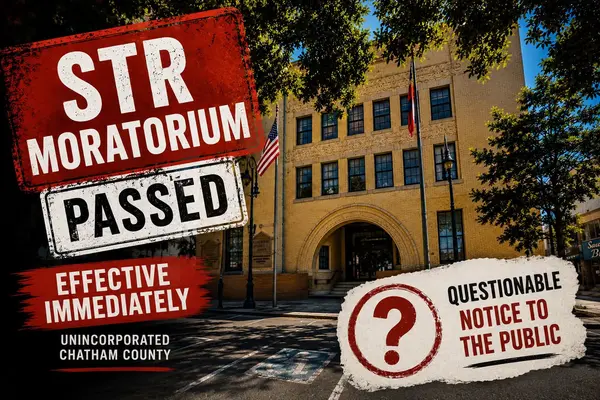
STVR Moratorium in Unincorporated Chatham County
STVR MORATORIUM PASSED! This is for unincorporated Chatham County homes only. It officially passed this morning, Friday, July 10th, 2026, very quickly. Every commissioner voted in favor except Noha. It is effective IMMEDIATELY. Just the mere possibility of a moratorium sparked a rush of STVR app
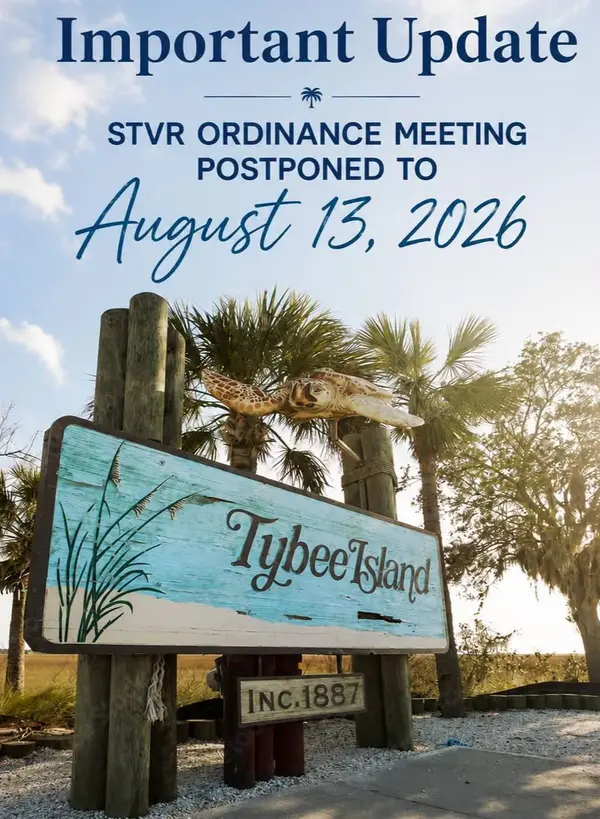
Tybee STR Ordinance Update: Tonight’s Public Hearing Has Been Postponed to August 13, 2026
Many of you planned to attend the Tybee Island City Council meeting on 7/9 for the public hearing on the proposed Short Term Rental (STR) ordinance. Unfortunately, “the required legal advertisement was not published for the full required time” before the meeting, so the public hearing could not le