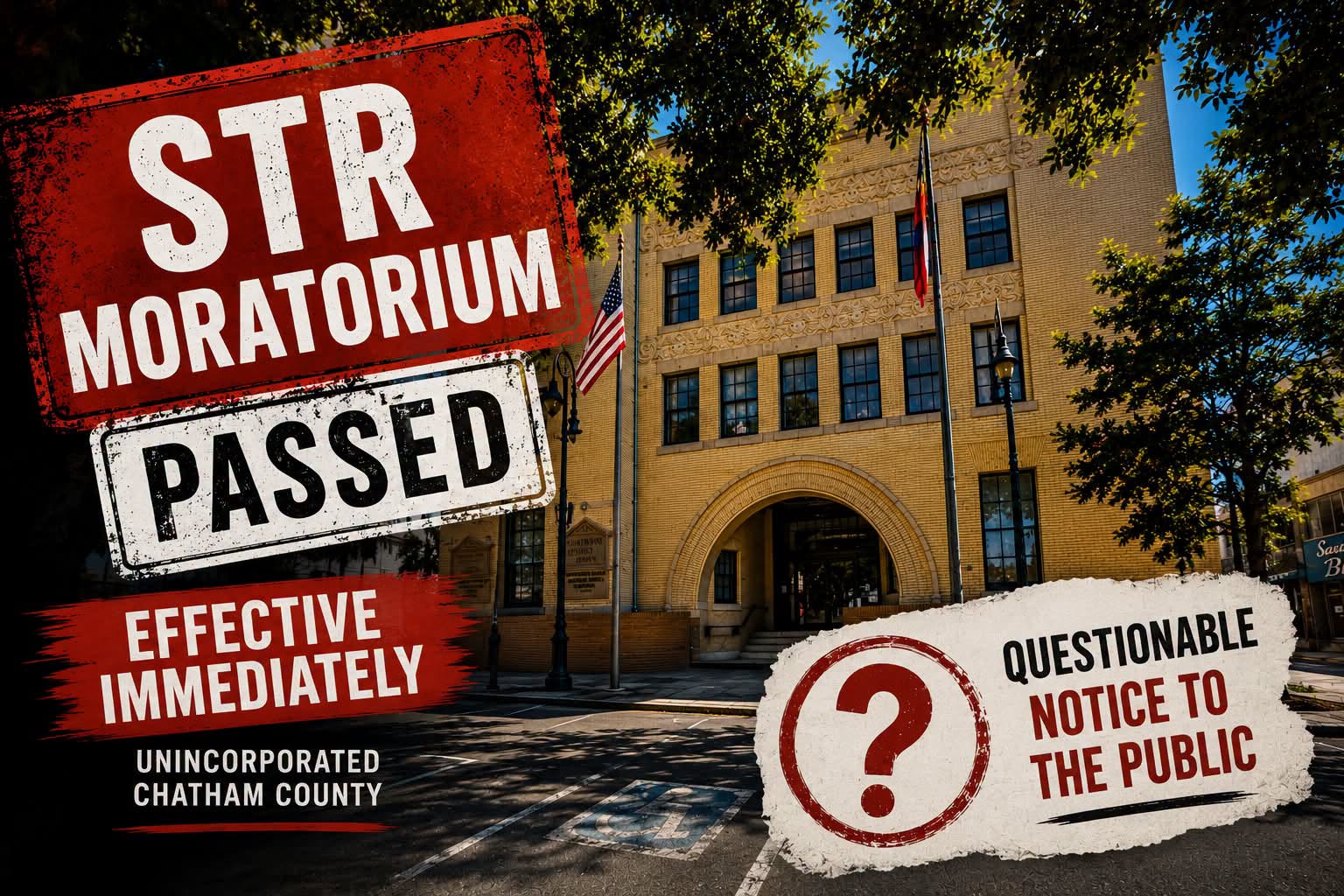
STVR MORATORIUM PASSED! This is for unincorporated Chatham County homes only. It officially passed this morning, Friday, July 10th, 2026, very quickly. Every commissioner voted in favor except Noha. It is effective IMMEDIATELY.
Just the mere possibility of a moratorium sparked a rush of STVR applications over the past two days. Most people didn’t even learn this was being considered until Wednesday, and by 9:30 a.m. Friday morning, the moratorium had already been approved. Does this meet the public notice requirement?!
One thing that’s hard to ignore is how little time the public had to react to the published agenda on the County Website. The majority of property owners didn’t even know a moratorium was being considered until Wednesday. By 9:30 a.m. Friday, it had already been approved.
The agenda circulated at the meeting today said that the STVR ordinance was a tabled item for reconsideration and *no mention of a moratorium*. This is a major private property rights issue that’s at stake and the public deserves to know if a moratorium is going to be considered.
Something the Property Owner’s on Tybee learned the hard way was that a resolution doesn’t require two public hearings and a vote and a resolution can be used for a moratorium. I remember hearing a Tybee City Council member that was an attorney say “oh we can just push this through under a resolution!” A resolution can be passed with just one vote and that’s the sneaky thing about what happened here. It’s the exact same way that it went down on Tybee Island.
Whether intentional or not, the result was the same: homeowners, buyers, sellers, and real estate professionals had very little time to understand the proposal, ask questions, or adjust their plans before a decision with potentially significant property rights implications was made. Simply put a moratorium was not necessary. People were upset about bad actors in the community and a moratorium does not resolve that. It is not necessary to have a moratorium to come up with better rules or enforcement. Enforcement again is the issue.
Here is my take y’all is that good public policy requires transparency with ADEQUATE public notice and enough time for the people affected to participate in the process!!! That did NOT occur today.
Now the biggest question is: What exactly does this mean for property owners, buyers, and sellers?
There are still several important questions that need to be answered.
• If a home already has an STVR certificate and is under contract, will the buyer still be able to apply for their own certificate during the moratorium?
• If a home sells after the moratorium takes effect, will the new owner be able to apply if the property previously held an STVR certificate?
• What happens to buyers who are already under contract and planning to operate an STVR?
• What about homeowners who have been operating without obtaining the required certificate? Will they still have an opportunity to apply?
For homeowners, this is another reminder that preserving your property’s future flexibility matters. Many people obtain an STVR certificate not because they operate a full-time vacation rental, but because they want to keep that option available if life circumstances change.
Future regulations could be based on density, spacing between properties, or other criteria. We simply don’t know yet what the permanent ordinance will look like. Chatham County is way too geographically diverse for a one size fits all approach. The needs of one community can be completely different from another. Trying to regulate the entire county with the same set of rules just doesn’t make sense. The County Commissioners need to recognize those differences instead of pretending every neighborhood is the same.
What we do know is that discussing a moratorium created a surge in applications almost immediately. This was a poorly planned MONEY GRAB!

With only about two days between the public becoming aware of the proposal and the vote itself, many property owners had very little time to evaluate their options.
I’ve said it all along: address nuisance properties and enforce the rules against bad actors. Those properties should absolutely be held accountable. But broad restrictions that affect every property owner are a different approach and they have real consequences for buyers, sellers, and the local real estate market that these Commissioners are not thinking of and it’s important they hear how they can affect real property owners.
The next step is getting answers about how the moratorium will apply to pending contracts, existing certificates, and future applications so property owners know where they stand. I’ll keep you updated as I learn more.